
 Huawei · Thailand
Products: Generations & Dispensers
Two generations of the FusionCharge platform serve Thailand today — the proven A2/A3 line and the new A5 generation — each with matched dispensers for every site type.
Two generations, one platform philosophy
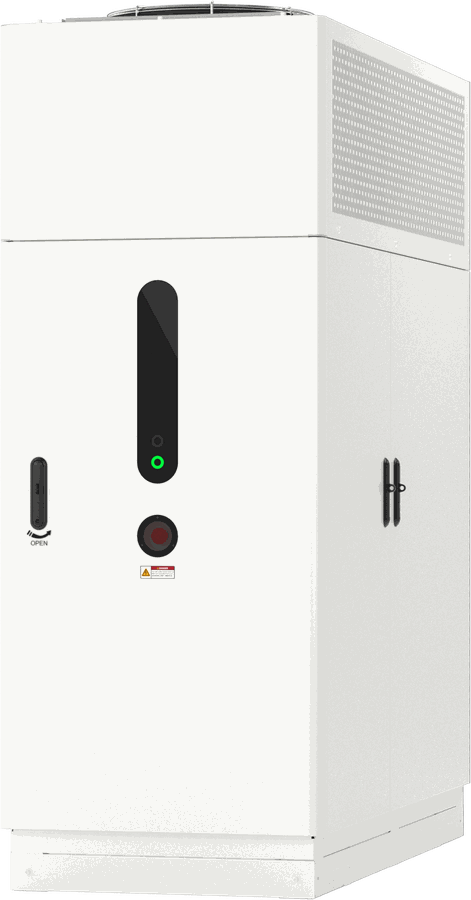
Every FusionCharge station uses the same split-type recipe: a central Power Unit with liquid-cooled power modules, feeding slim dispensers at each bay. Smart power sharing routes capacity to the guns in use, so the station serves every car with the power available.
Each generation pairs only with its own dispensers — A2/A3 dispensers do not connect to an A5 Power Unit, and vice versa.
The generations at a glance
A2 / A3 — in market since 2025
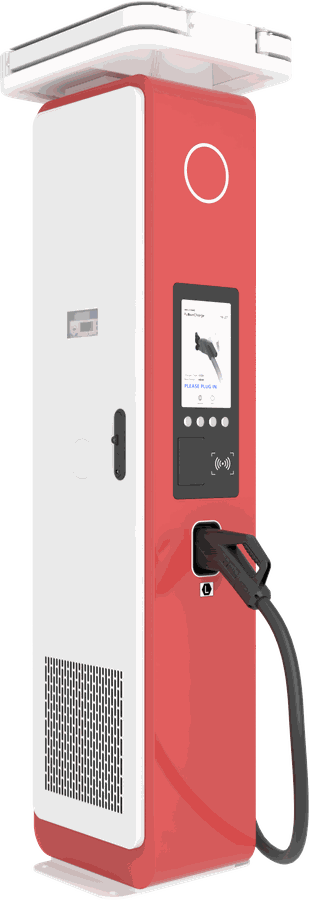
The generation that built Thailand's first Huawei ultrafast stations. Power Units up to 720 kW (A2, up to 12 guns) or 360 kW (A3, up to 6 guns). Its signature is the red liquid-cooled dispenser: coolant circulates inside the cable itself, letting a slim, light cable sustain a full 500 A. Output 200–1000 Vdc.
A5 — selling from June 2026
The new white Power Unit. One model covers 240–720 kW: it ships at a base configuration and is upgradeable in the field in 120 kW steps — grow the station's power as demand grows, without replacing hardware. Supports both AC- and DC-coupled battery storage (BESS); solar PV always connects on the AC side. Output 150–1000 Vdc.
The hardware
A5 dispenser lineup
| Model | Cable | Guns | Max current | Best for |
|---|---|---|---|---|
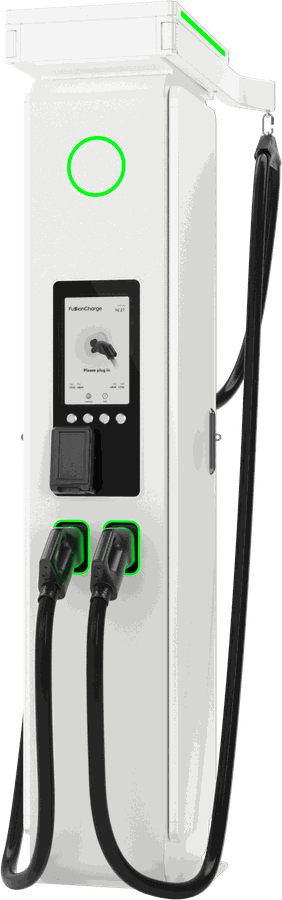
| DT600N2-EUA1 | 5 m, natural cooling | 2× CCS2 | 600 A per gun | Standard choice — all scenarios |
| DT600N2-EUA2 | 7.5 m, natural cooling | 2× CCS2 | 600 A per gun | Truck & fleet stations (longer reach) |
| DT800L1-EUA1 | 5 m, liquid-cooled | 1× CCS2 | 800 A max (600 A rated) | Flagship — the highest charging current in Thailand |
The A5 dispensers
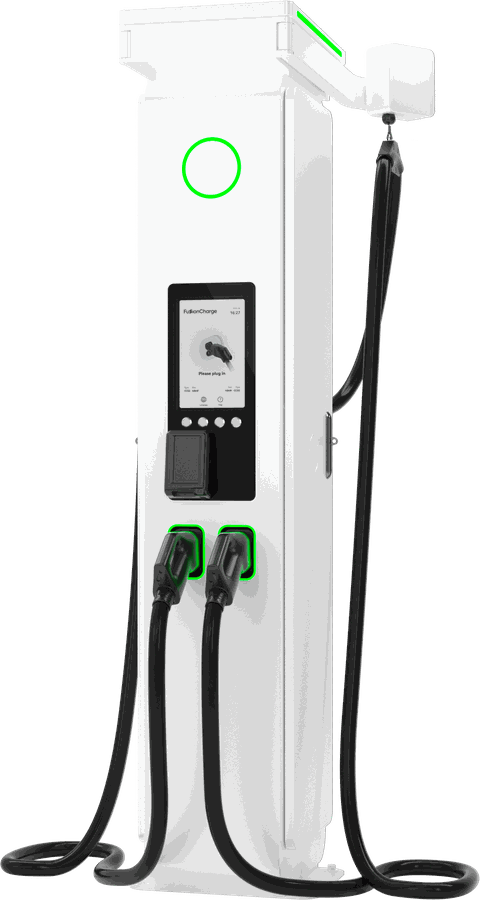
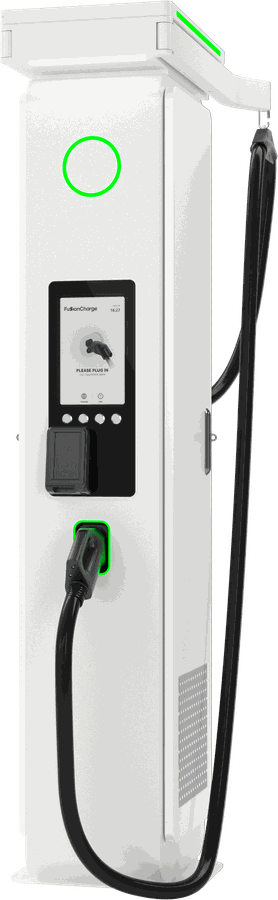
The 800 A flagship gun
The DT800L1-EUA1 pairs a liquid-cooled cable with the A5 Power Unit to deliver up to 800 A into a single gun — the highest charging current available in Thailand. One flagship gun can push around 600 kW into an 800V-class vehicle — ideal for hero stalls, brand-showcase hubs and premium flagship sites.
Why a standard gun tops out lower: inside the Power Unit, each output port reaches a fixed set of DC/DC channels — 6 channels (360 kW) on a standard port, 8 (480 kW) on an ultrafast port. That is a wiring-reach limit, not a product limit, and it is what the simulator on the home page is showing you. Bonding two ports is what takes the flagship gun past it.
One status note: the A5 Power Unit and the DT600N2 dispensers are on PEA's public equipment register — the table further down this page lists every registered combination. The DT800L1-EUA1 carries its own separate model number and its registration is in progress. PEA's connection rules allow an unregistered charger to be connected on its submitted test reports, reviewed case by case, so on a flagship build this is a paperwork step rather than a feasibility question. Ask us for the current status before you plan around it.
How we define it: speed & station size
| Term | Our definition |
|---|---|
| DC Fast | Charger power below 240 kW |
| Ultrafast | Charger power 240 kW or more |
| Ultrafast station | 6 or more DC guns, each rated 240 kW or more |
Power Unit — installation specifications
| Specification | DS720-720LEUA5 |
|---|---|
| Dimensions (W × D × H) | 1700 × 800 × 2150 mm |
| Weight (incl. coolant) | 1250 kg (240-360) · 1350 kg (240-720) · 1400 kg (480-600) · 1500 kg (600-720 / 720-720) |
| Installation | Floor-mounted |
| Ingress protection | IP55 |
| Rated input voltage | 400 Vac ±10%, three-phase five-wire |
| Rated frequency | 45–66 Hz |
| Rated input current | ≤373 A (240-360 / 240-720) · ≤745 A (480-600) · ≤931 A (600-720) · ≤1117 A (720-720) |
| Power factor | ≥0.99 at ≥50% load |
| THDi | ≤5% at ≥50% load |
| Output voltage | 150–1000 Vdc |
| Maximum efficiency | 96% |
| Standby power | 45 W |
| Cooling | Liquid cooling |
| Operating temperature | −35 °C to +50 °C |
| Relative humidity | 5–95% non-condensing |
| Altitude | ≤4000 m |
| Noise | 61.6 dB(A) at 720 kW (standard mode) · 55.7 dB(A) at 600 kW · 51.3 dB(A) in silent mode — all at 1 m, Huawei lab measurement |
| Northbound communication | 4G, Ethernet |
| Compliance | IEC 61851-1, IEC 61851-23, IEC 61851-21-2 |
Dispensers — installation specifications
| Specification | DT800L1-EUA1 | DT600N2-EUA1 | DT600N2-EUA2 |
|---|---|---|---|
| Dimensions (W × D × H) | 395 × 495 × 2150 mm | 395 × 495 × 2150 mm | 395 × 495 × 2000 mm |
| Connectors | 1 × CCS2 | 2 × CCS2 | 2 × CCS2 |
| Cable length | 5 m | 5 m | 7.5 m |
| Cable cooling | Liquid | Natural | Natural |
| Rated output current per connector | 600 A | 375 A | 375 A |
| Maximum output current per connector | 800 A | 600 A | 600 A |
| Output voltage | 150–1000 Vdc | 150–1000 Vdc | 150–1000 Vdc |
| Ingress protection | IP55 | IP55 | IP55 |
| Installation | Floor-mounted | Floor-mounted | Floor-mounted |
| Standby power | 35 W | 35 W | 35 W |
| Metering certification | MID / LNE | MID / LNE | MID / LNE |
| Operating temperature | −30 °C to +55 °C (derating from 40 °C) | −30 °C to +55 °C (derating from 40 °C) | −30 °C to +55 °C (derating from 40 °C) |
Download the datasheets
Registered with PEA — and you can check it yourself
| Registered combination | Station output | Guns | Listed | Valid to |
|---|---|---|---|---|
| A5 · DS720-720LEUA5 + DT600N2-EUA1 | 360 kW | 6 | 20 Jul 2026 | 20 Jul 2029 |
| A5 · DS720-720LEUA5 + DT600N2-EUA1 | 480 kW | 10 | 20 Jul 2026 | 20 Jul 2029 |
| A5 · DS720-720LEUA5 + DT600N2-EUA1 | 720 kW | 12 | 20 Jul 2026 | 20 Jul 2029 |
| A5 · DS720-720LEUA5 + DT600N2-EUA2 (7.5 m) | 720 kW | 12 | 20 Jul 2026 | 20 Jul 2029 |
| A3 · DS720-720LEUA3 + DT500N2 | 240 kW | 6 | 11 Sep 2025 | 11 Sep 2028 |
| A3 · DS720-720LEUA3 + DT500L1 | 240 kW | 4 | 11 Sep 2025 | 11 Sep 2028 |
| A3 · DS720-720LEUA3 + DT500L1 + DT500N2 | 240 kW | 6 | 11 Sep 2025 | 11 Sep 2028 |
| A2 · DS720-720LEUA2 + DT500L1 | 720 kW | 8 | 4 Apr 2025 | 4 Apr 2028 |
| A2 · DS720-720LEUA2 + DT500N2 | 720 kW | 12 | 4 Apr 2025 | 4 Apr 2028 |
| A2 · DS720-720LEUA2 + DT500L1 + DT500N2 | 720 kW | 12 | 4 Apr 2025 | 4 Apr 2028 |
Verify it on PEA's register
Can I mix A2/A3 dispensers with an A5 Power Unit?
No. Each generation pairs only with its own dispensers. A5 Power Units use the white DT600N2 / DT800L1 lineup; A2/A3 use the DT500 series.
How does power sharing work?
Smart power sharing routes the Power Unit's capacity to the guns in use — when a car unplugs, its power immediately becomes available to the cars still charging. Try the interactive simulator on the home page — it runs the real Power Unit wiring.
Can I run these on my own CMS, or am I locked into Huawei's platform?
You are not locked in. The Power Unit exposes northbound communication over Ethernet or 4G for connection to a charge-point management system, and Huawei equipment is already running in Thailand under several different third-party operator platforms — the station map on this site includes sites on more than one network. For the specific protocol version and message set your CMS needs, ask us and we will confirm it in writing against the release you would be deploying rather than a general claim.
Which vehicle-side standards do the dispensers implement?
Per the official product datasheet: IEC 61851-1, -23, -24 and -21-2, IEC 62196-1 and 62196-3 for the CCS2 connector, DIN 70121 and ISO 15118-2 — so both the older DIN sequence and the ISO 15118 communication a modern 800 V vehicle expects. Authentication is RFID (ISO/IEC 14443 A/B, ISO/IEC 15693, NFC) or QR, with an optional credit-card reader, and the meters carry MID / LNE certification for billable energy.
If my platform sets a charging profile, how does that interact with the Power Unit's own power sharing?
They work at two different levels. An externally set limit caps what the station may draw; the Power Unit's internal sharing then allocates whatever is available across the guns actually in use, within the wiring-matrix reach of each port. So an external profile constrains the total, and the Power Unit decides the split — you do not have to manage per-gun allocation yourself. Confirm the exact command set with us for your platform before you build against it.
Who owns the charging data?
The station operator does. Session and metering data belongs to whoever operates the station, and if you run your own CMS it goes to your platform. If you would like this written into the supply terms rather than taken on trust, say so and we will put it in the agreement.
Can I add solar and battery storage later?
Yes. The A5 generation supports both AC- and DC-coupled BESS, and solar PV connects on the AC side — a station can start charger-only and add PV + BESS when the economics fit.
See the full A5 station range
From a 240 kW city site to megawatt charging infrastructure — a 960 kW, 20-gun hub is the most connectors on offer in this market, and two 720 kW Power Units in parallel reach 1,440 kW.
Talk to us about your site
Leave your details and Ralph and the Thailand FusionCharge team will come back to you with numbers for your specific location.